
Why Do Teeth Hurt From Grinding? A Dentist Explains the Pain

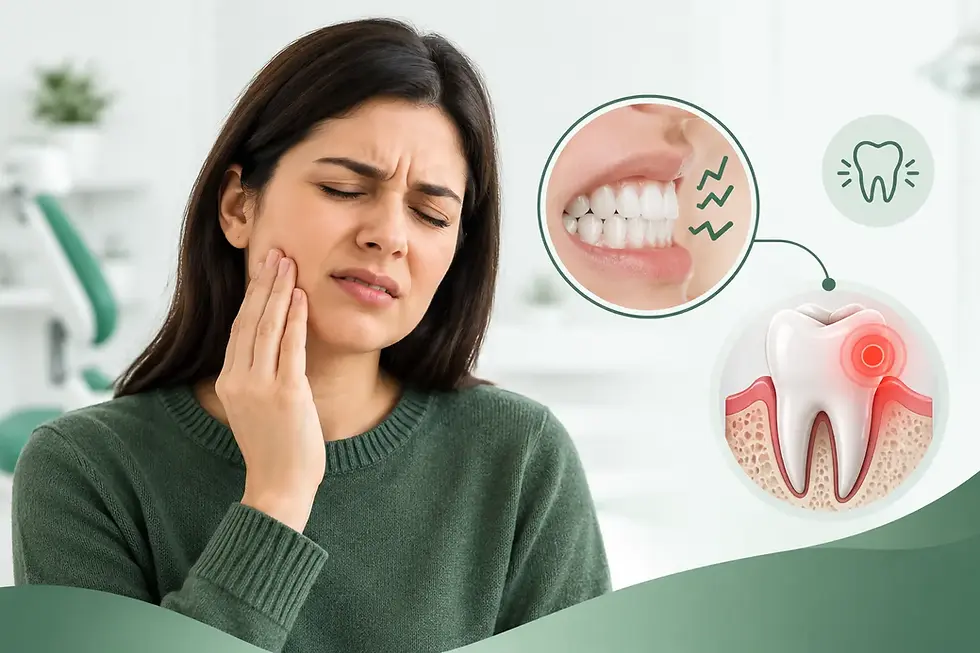
Waking up with teeth that ache, feel loose, or zing when you sip something cold is one of the most common ways bruxism teeth pain shows up. Grinding doesn't damage a tooth the way decay does. It overloads the tooth, the ligament holding it in its socket, and the muscles doing the squeezing.
That's why this pain wanders. It swaps sides, skips a week, then comes back after a bad month at work. At Appin Dental Surgery, we regularly see patients across Wollondilly who have had three separate teeth checked with nothing found on any of them.
So here's what the ache is actually telling you.
Why Do Your Teeth Hurt From Grinding?
Grinding hurts your teeth because of pressure, not infection. A normal bite puts your teeth together for a few minutes across a whole day. Sleep grinding can hold them clamped for an hour or more, with forces well above normal chewing.
Five things create the pain:
Strained periodontal ligament. Every tooth sits in a thin cushion of fibres. Squeeze it for hours and it becomes inflamed, the same way an overworked joint does. This is the dull, achy, bruised-feeling pain, and it's the one we see most.
Worn enamel exposing dentine. Once the outer layer flattens off, the softer layer underneath carries thousands of tiny tubes that run to the nerve. Cold air and cold drinks travel straight down them.
Microcracks in the enamel. Repeated flexing opens hairline splits, usually in the back teeth.
Inflamed pulp. Long-term overload can irritate the nerve inside the tooth, which produces a deeper, slower throb.
Referred muscle pain. Tight chewing muscles send pain into the upper back teeth even when those teeth are perfectly healthy.
What Does Grinding Tooth Pain Actually Feel Like?
Grinding pain has a signature, and the type of ache points to the mechanism behind it.
What you feel | Likely cause | Typical timing |
Dull ache across several teeth, feels bruised | Strained periodontal ligament | Worst on waking, eases by mid-morning |
Short, sharp zing with cold | Worn enamel, exposed dentine | Triggered, stops within seconds |
Sharp jab when you bite down, or when you let go | Cracked cusp or microcrack | Random, food-dependent |
Deep throb that lingers after the trigger | Irritated nerve | Any time, often worse lying down |
Ache in upper back teeth, but the tooth checks out fine | Referred muscle pain | Builds through the day |
The pain on release of a bite is the one worth flagging to your dentist. Pain when the pressure comes off, rather than when it goes on, is a classic pattern for a cracked cusp, and it often shows up long before a crack is visible on an x-ray.
Is It Grinding, Or Is It a Cavity?
Grinding pain moves. Decay pain doesn't.
That single difference sorts most cases. A cavity is one tooth with one problem, and it gets worse week by week in a fairly predictable line. Grinding pain shifts between teeth, changes sides, flares during stressful stretches, and settles down again without any treatment at all.
A few other tells:
Grinding pain is usually symmetrical or roaming. Decay is stubbornly local.
Grinding pain is loudest in the morning. Decay doesn't care what time it is.
Grinding pain often comes with a tight jaw, sore temples, or a headache behind the eyes. A cavity rarely brings company.
Sweet things provoke decay. Cold and pressure provoke grinding damage.
None of this replaces an examination. Both can be present at once, and we do see patients who came in convinced it was grinding and left with a filling. But if you've had several teeth checked and cleared, and the ache keeps relocating, grinding is the thing to raise at your next visit.
What Are the Early Signs of Teeth Grinding?
The early signs of teeth grinding usually show up on the teeth before they show up as pain. Most people have no idea they're doing it, because teeth grinding happens involuntarily, most often during sleep.
Here's what we look for at a routine check-up:
Flat, polished patches on the canines and front teeth. Healthy canines have a point. Grinders wear them to a flat edge, and the flattened surface is often shiny.
A ridge along the inside of the cheek. A pale horizontal line sitting level with the bite.
Scalloped edges on the tongue. Indentations where the tongue presses against the teeth during clenching.
Chipped filling margins. Small fractures at the edge of white fillings are frequently the first structural sign.
Morning headaches or a tight jaw. Particularly ones that fade after an hour or two awake.
Noise at night. A partner hearing it is still one of the most reliable clues.
Grinding is common. About half the population does it occasionally, and roughly 5% grind regularly. Occasional grinding often does little harm. The regular, forceful version is the one that wears teeth down.
Why Does It Hit Your Back Teeth and Jawline?
Your molars take the load because they sit closest to the hinge. Think of your jaw as a nutcracker: the closer to the pivot, the higher the force. That's why grinding damage shows up as flattened molars and cracked back teeth long before the front teeth complain.
The jawline change is a separate thing. The masseter, the thick muscle at the angle of your jaw, grows with use like any other muscle. Years of clenching can broaden the lower face, which patients often notice in photos before they notice any pain. It isn't harmful on its own, but it's a useful sign that the clenching has been going on for a while.
Morning Pain or Afternoon Pain? What the Timing Tells You
Timing separates the two forms of bruxism, and they need different approaches.
The current international consensus splits bruxism into sleep bruxism and awake bruxism, and treats it as muscle behaviour rather than a disease in otherwise healthy people. That distinction matters for you practically:
Pain worst on waking, easing through the morning: sleep bruxism. A protective splint worn overnight is the usual starting point, since you can't consciously control it.
Pain that builds through the day and peaks by late afternoon: awake clenching. A night splint won't touch this one. Daytime habit awareness does the work.
Both: more common than people expect, and the reason some patients wear a splint faithfully and still get sore.
A simple test: notice where your teeth are right now, before you read on. They should be apart, with lips together. If they were touching, you clench while awake.
What Damage Does Grinding Do to Teeth Over Time?
Left unmanaged, forceful grinding wears enamel, cracks back teeth, and shortens the life of fillings and crowns. The sequence is usually slow, and it's measured in years rather than months.
What we see across the Macarthur region, in rough order of appearance: flattened biting surfaces, then sensitivity as dentine gets exposed, then chipped restoration edges, then cracked cusps, then teeth that need dental crowns to hold them together. Gum recession sometimes accompanies heavy grinding, though the research on that link is still unsettled.
The earlier the wear is picked up, the less rebuilding is needed. Small worn areas can often be restored with white fillings rather than full coverage. That's the practical case for mentioning it at a check-up rather than waiting for something to break.
Getting Grinding Pain Checked at Appin Dental
If your teeth ache in the morning and nothing obvious has turned up, it's worth a proper look at the wear pattern. An examination can usually tell us whether the damage is grinding-related, how advanced it is, and whether a protective appliance makes sense for you. Our occlusal splints and night guards in Appin are made from digital scans by Australian dental laboratories.
Worth knowing if you're a veteran: splint treatment may be available through the DVA Dental Services Scheme, and Appin Dental Surgery treats eligible DVA patients. Very few people realise this is covered.
If the ache is mostly in the joint rather than the teeth, our guide to jaw pain on one side covers that ground. If cold sensitivity is the main complaint, start with sensitive teeth.
Families from Wilton, Picton and the newer estates make up a good share of the grinding cases our team sees, and we notice the enquiries climb through exam season and the end of the financial year. Stress leaves marks on teeth.
Call Appin Dental Surgery on (02) 90681369, or book online, and we'll take a look.
Frequently Asked Questions
Can teeth grinding cause tooth pain without any visible damage?
Yes. The most common source of grinding pain is inflammation in the ligament around the tooth, which doesn't show on an x-ray or as a mark on the tooth. The tooth can look perfect and still ache.
How long does bruxism tooth pain last?
Ligament-related ache often settles within a few hours of waking, and calms over a week or two once the grinding reduces. Pain that lasts beyond that, or that lingers after cold, suggests something structural and should be examined.
Can teeth grinding cause cavities?
Not directly. Grinding doesn't create decay, but it wears enamel and chips filling edges, and those damaged areas trap plaque and become harder to clean. Decay can follow from that.
Does a mouthguard stop grinding?
A splint protects the teeth from the force. It generally won't stop the grinding itself, which is why most cases also need the trigger addressed.
Why does grinding pain show up on some mornings and not others?
Grinding intensity varies night to night with stress, sleep quality, alcohol and some medications. A bad night produces a sore morning, and a settled night produces nothing at all.


Comments